What a finding is, what one delivery contains.
What you receive is a finding: one thing described in several separate pieces of feedback, written to a fixed structure, with the customers' own words that support it attached. On the product's own screens a finding is called a discovery artefact.
A topic is the area of your customers' experience you chose to cover. Each finding is delivered to every destination you chose for that topic: the Slack channel, Notion page, Linear team or webhook address you connected.
The four types of finding
Every finding is one of four types, and each type has its own sections. Every finding of one type has the same sections in the same order, so a finding delivered this month can be compared with one delivered last year.
A Problem statement describes a difficulty someone has: who they are, how they feel, what the difficulty is about, what they need to do and why, and what stands in their way.
A Need statement describes something someone wants to be able to do: who they are, when the need arises, what they want to do, and what that lets them achieve.
A How might we describes an improvement to explore: what could be better for the person, who it is for, and what that lets that person achieve.
A Job to be done is a short statement of what someone is trying to do, in three parts: a Verb, the Object the verb acts on, and a Clarifier that limits it.
What one delivery contains
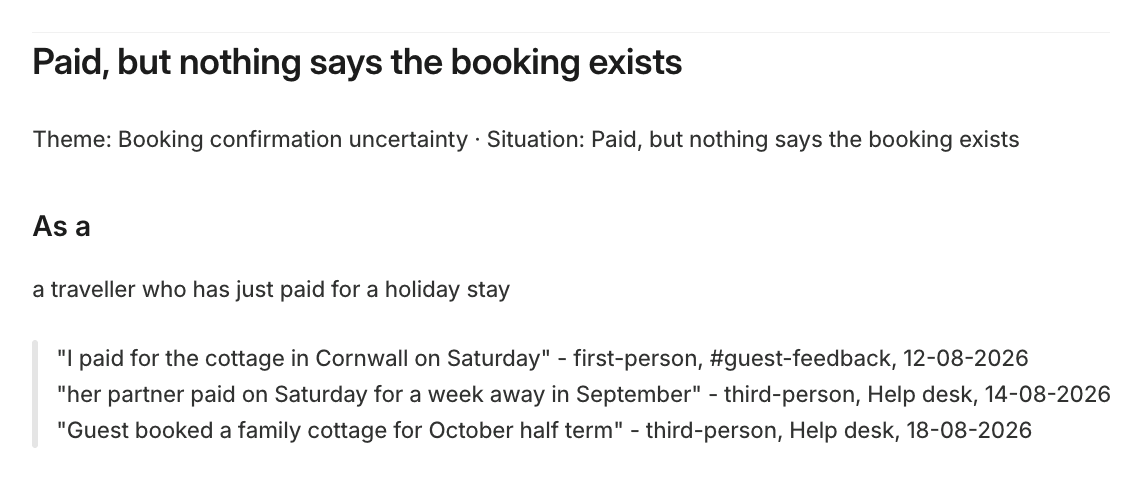
Each finding is its own delivery: one Linear issue, one Slack message, one Notion row, or one request to your webhook address.
Then come the sections, and the quotes that support them. In Linear each quote sits under the heading of the section it supports. In Slack the sections come first as one block, then a dividing line, then a list headed Evidence, in which the quotes are grouped by section.
Each quote is in the person's own words. It is marked first-person when the person describes their own experience, or third-person when the person describes someone else's, and it carries the source it came from and its date. No quote names the person who wrote it.
A Confidence line states how far the evidence reaches, and a Does not cover line states what the evidence does not cover.
Under Why these scores, each measure has a score out of 100 and the reason for it.
A delivery ends with one link, Change this topic, which opens the topic so you can change its wording.
When findings arrive
A cycle is one pass over a batch of feedback, and starts when about twenty pieces have arrived. Feedback you import starts a cycle without waiting for twenty. The first findings usually take between several weeks and two months, depending on how much feedback arrives. To see findings sooner, import past feedback or connect another source.