The six sections of a Problem statement, what each one tells you, and what each one never says.
A Problem statement is one kind of finding you receive. It describes a struggle: something unwelcome that more than one piece of feedback describes. It has six sections.
The sections come in this order: As a, Who feels, About, I need to, So that, But I face. Each section is written to follow its own label, so the label and the text read together as one phrase. The six together describe one person in one situation, written as that person would say it.
Above the sections is the title, which names the situation.
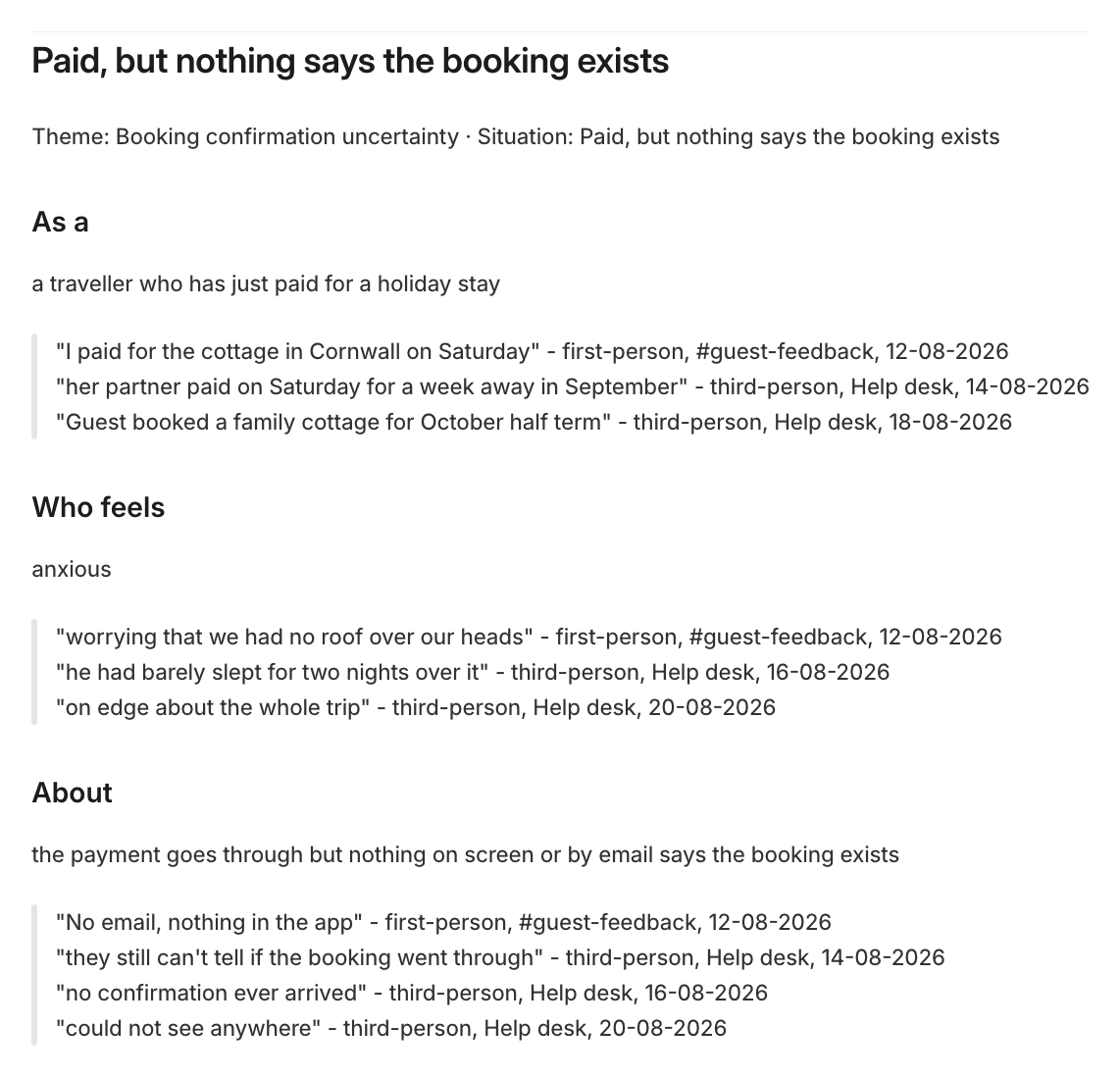
As a
Who the person is, and the situation that makes this struggle theirs. It names one person in one situation, not a group and not a type of customer. This section may name a product, a company or a department, because that is the situation the person was in. It does not say what happened: that belongs to About.
One person in one situation, not a type of customer. For example:
As a traveller who has just paid for a holiday stay
Who feels
The emotion the person described. This section names one emotion, usually in one word. People rarely name an emotion directly, so the word comes from the way they described the moment. It is not an opinion about a product or a team. "Frustrated" is a feeling. "Frustrated with the booking page" adds an opinion about a product, and this section holds the feeling alone.
One word that names a feeling. For example:
Who feels anxious
About
What happened: the event or situation, stated simply. This section may name the screen, the product or the department involved. It does not explain why it happened, and it does not say what the person had to do afterwards. The consequence belongs to But I face.
The event alone, without its consequence. For example:
About the payment goes through but nothing on screen or by email says the booking exists
I need to
What the person was trying to do in their life at the time of the struggle. It is written as "I", with the person as the one acting. This section never names a product, a system, a brand, a company or a department, because it describes the person's life rather than the product. Everyday things that any person has, such as a phone or a bank account, are allowed. The test is whether a person could wake up wanting it: "know my stay is confirmed" passes, "use the confirmation feature" does not.
A need in the person's life, with no product in it. For example:
I need to know the moment I pay that my stay is confirmed
So that
The outcome the person wanted from that need. Like I need to, it describes the person's life, and it never names a product, a system, a brand, a company or a department.
The outcome, as the person would want it. For example:
So that I can plan the rest of the trip without wondering whether I have somewhere to sleep
But I face
What remains for the person to do or endure because of the event: a difficulty, an obstacle or a burden. It is not the event itself, which About has already stated. It is the work, the wait or the uncertainty that followed. This section may name a product or a department, and it is written from the person's side, not in your organisation's internal terms.
The consequence for the person, not the event that caused it. For example:
But I face phoning support to ask a person to check, because nothing I can see will tell me
What is true of all six sections
Each section holds one thing: one person, one emotion, one event, one need, one outcome, one difficulty. All six describe the same person in the same situation, and no two sections say the same thing.
Confidence, and what the finding does not cover
The sections come with lines that state the limits of the evidence. A line beginning Confidence: states the limit of what this feedback can say. A line beginning Does not cover: states what the feedback cannot be used to claim. These lines are sentences, not scores. Read them before you use the sections.
The evidence, and the limit of what it can say. For example:
- Confidence: Six feedback items across two channels, five of them second-hand.
- Does not cover: Whether the payment itself failed or was taken twice; every account here says the money went through.