Read the quotes, the Confidence note, the scores and the labels that arrive with each finding, and what each one lets you change.
Every finding is delivered with the evidence it is based on. The evidence has four parts. Under each section of the finding are the quotes that support it. Then comes a note called Confidence, and a set of scores called Why these scores, each score with a reason. In Linear there are also labels that state facts about the finding.
A Linear reader sees all four on the issue: the sections with their quotes, then the Confidence note, then the scores table, with the labels on the issue itself. A Slack reader sees three, and every score with its reason is a reply under the message.
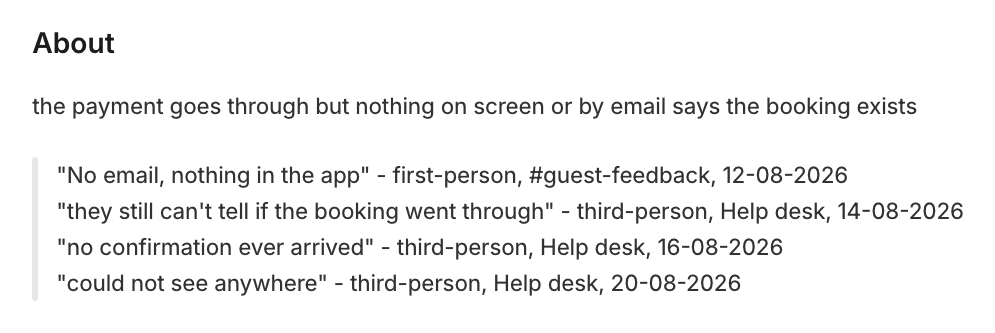
Dates in a finding are written as day, month, year. 12-03-2026 is 12 March 2026.
The quotes
Under each section of a finding are the quotes that support that section. Each quote comes from one piece of feedback. A Linear reader finds the quotes under the section's own heading. A Slack reader finds them after the sections, under Evidence, grouped by section, with the number of quotes in the heading.
What you read is the part of the feedback that supports that section, not always the whole message. That part is taken from the feedback word for word. When one piece of feedback supports two sections, a different part of it usually appears under each.
At most five quotes are shown under one section. A finding can be supported by more feedback than the five quotes you see.
After each quote you see its voice, its source and its date. Any of the three reads unknown when the finding does not carry it.
Read the part after the quote: who said it, where it came from, and when. For example:
"paid on Tuesday and there is still nothing in my inbox that says the booking exists" - first-person, support-inbox, 12-03-2026
First-person and third-person
A first-person quote is the person who had the experience speaking for themselves: "I paid twice". "We have been waiting three weeks", from a team describing its own case, is first-person too. A third-person quote is someone describing another person's experience: "the customer reported that she paid twice". A quote inside a report written by someone else is still third-person, because someone else chose it and wrote it down.
First-person quotes are given more weight. A person describing their own experience gives a more direct account than a person describing it for them. Third-person quotes always count as well, and a finding supported mostly by them is a weaker finding.
A Linear reader also sees the voice mix as a label on the issue: first-person only, third-person only or mixed, under echoux:voice. Both destinations carry a line with the counts, under the scores table in Linear and in the reply in Slack: 3 quotes from support-inbox · 1 first-person, 2 third-person · evidence 12-03-2026 to 01-08-2026.
The Confidence note
A note called Confidence states the limit of what the finding says. It has up to four lines, and a line appears only when it was written.
- Confidence: how precisely the evidence supports the finding, and where that precision ends;
- Does not cover: what the evidence does not support, so the finding does not claim it;
- Alternative reading considered: another way the same quotes could be read;
- Set aside because: why the delivered wording was kept and the alternative was not, with the quotes that decide it.
A Linear reader sees every line that was written, after the quotes. A Slack reader sees the first two only, joined into one line that sits under the sections and above the quotes. Alternative reading considered and Set aside because are not delivered to Slack.
Why these scores
Every finding carries scores, each out of 100, and a reason for each score. A Linear reader finds them in a table near the end of the issue, Why these scores, with the columns Facet (the score's name), Score and Why. A Slack reader finds them as a reply in the thread under the message, one line per score.
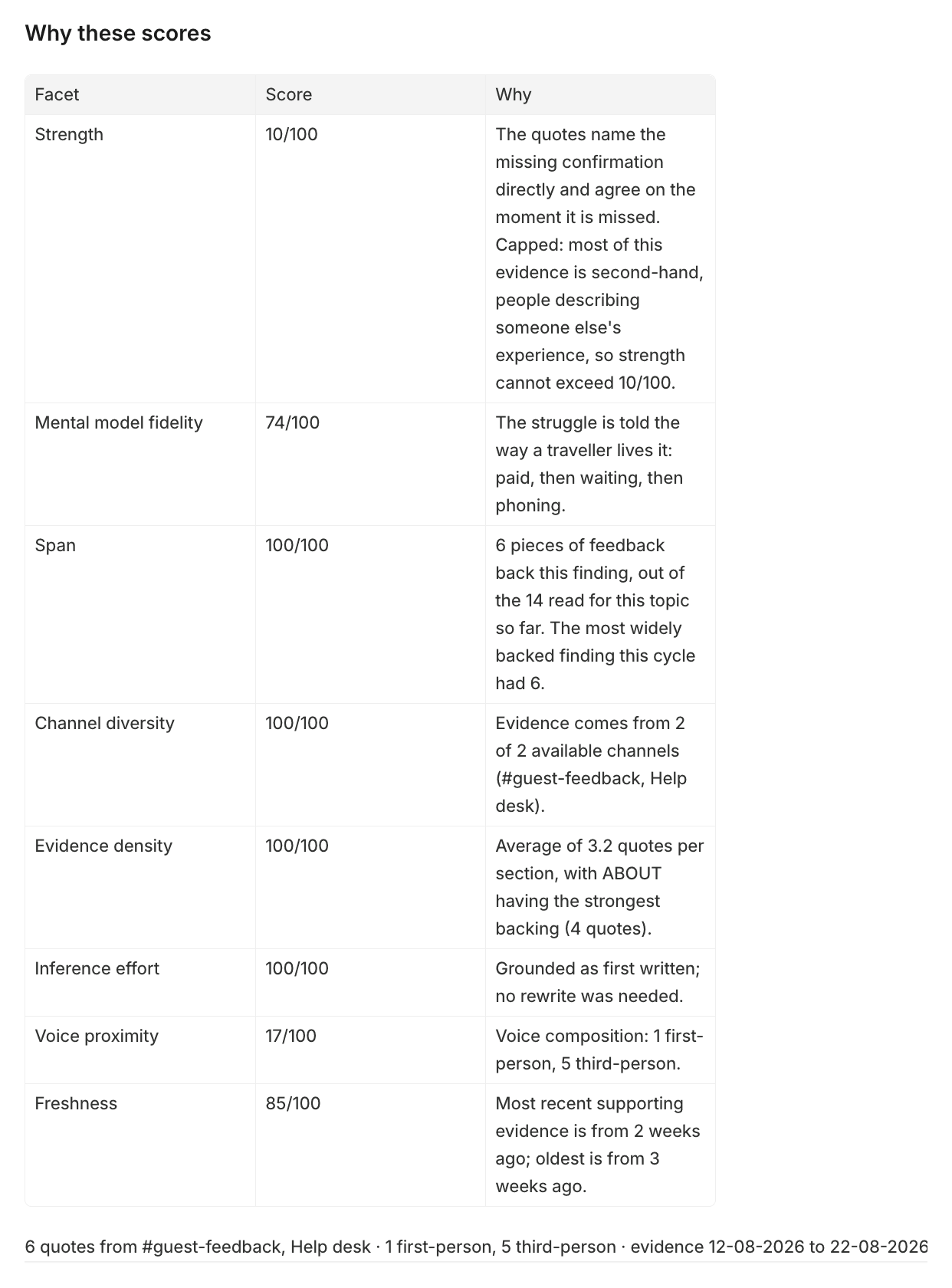
The scores, in the order they are shown:
- Strength: how well the quotes support what the finding says;
- Mental model fidelity: how closely the I need to, I want to and So that sections stay inside the way people described things themselves. Scored on a Problem statement and a Need statement only, so a How might we and a Job to be done carry one score fewer;
- Span: how many pieces of feedback support the finding;
- Channel diversity: how many of the sources that sent feedback into this topic the evidence comes from;
- Evidence density: the average number of quotes under each section;
- Voice proximity: the share of first-person feedback behind the finding;
- Freshness: how recent the evidence is.
Read the sentence that starts with "Capped": it gives the reason the score cannot be higher. For example:
Strength 10/100. The quotes name the missing confirmation directly and agree on the moment it is missed. Capped: most of this evidence is second-hand, people describing someone else's experience, so strength cannot exceed 10/100.
"Second-hand" in that sentence means third-person.
A score describes how well the finding is evidenced. It does not say how important the finding is.
When a score could not be given, the score cell reads Not scored, with the cause in the reason beside it.
The labels in Linear
Labels are on the issue in Linear, and a Slack reader does not have them. They state facts about the finding: its kind, its theme, the voice mix and each source the evidence came from. A label is never a score.
A theme is the subject the finding belongs to. Findings about the same subject carry the same theme, cycle after cycle. The theme's name is a label under the group echoux:theme. The kind is one of echoux:problem, echoux:need, echoux:how_might_we and echoux:jtbd. Each source is a label that starts with echoux:source:.
Two more labels appear when they apply. echoux:not scored is on an issue where a score could not be given. echoux:refined is on a finding that refines an earlier one.
When you disagree with a finding
There is no control on a delivered finding to reject it or to mark it as wrong, in Linear or in Slack. What you can change is the topic, and the change applies from the next cycle. Start with the quotes: a finding says only what its quotes support, so the quotes tell you which of these you have.
The quotes are about something outside your topic
The topic's wording did not leave them out. Change the wording, starting from Change this topic at the end of the finding, in Linear and in Slack alike; Sharpen a topic covers what to change. Findings already delivered are not changed.
The quotes are about your topic, and you read them differently
A Linear reader can read Alternative reading considered and Set aside because in the Confidence note: the reading you prefer may be there, with the reason it was not used. A Slack reader does not get those two lines. The delivered finding is not changed either way. When more feedback arrives on the same subject, a later cycle can deliver a refined finding. It is marked Refines an earlier finding, with the date of the earlier one when that one reached the same destination.
The wording goes further than a quote supports
Read the Does not cover: line, which states what the finding does not claim. A delivered finding cannot be corrected, so the two changes above are the ones open to you.
You do not agree with what the quotes say
There is nothing to change: the quotes are what your customers wrote.