Read the four sections of a Need statement, what each one tells you, and what each one is not allowed to say.
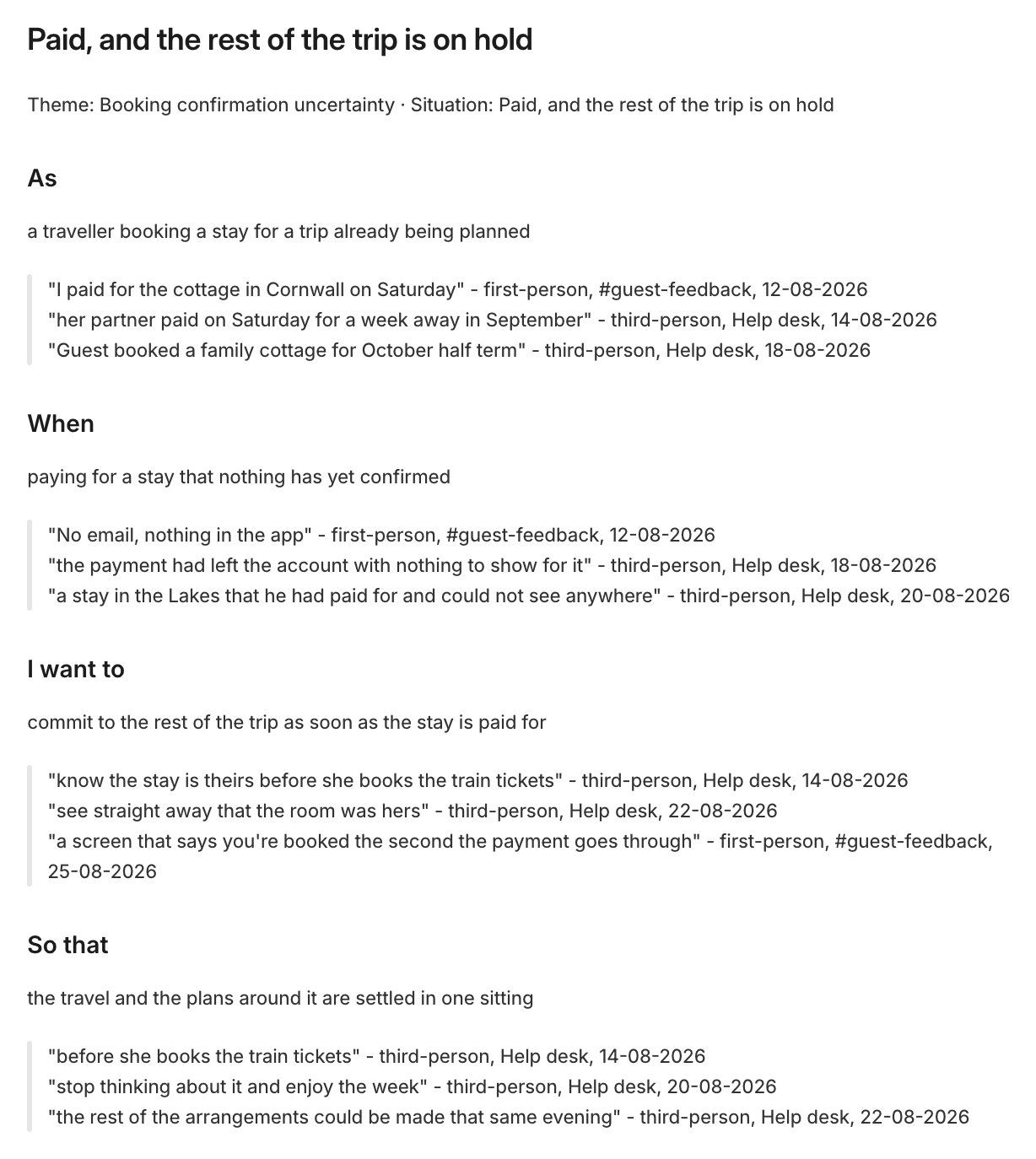
A Need statement is a finding about a capability: something a person wants to be able to do and cannot. It is one of four kinds of finding, all four described in What echoUX delivers, and why. It has four sections, and each one answers a different question about the same want.
The sections are delivered in this order: As, When, I want to, So that. Read the four labels with their text and they form one sentence, spoken by the person who has the want.
A Problem statement has six sections. A Need statement has four, and none of them describes an obstacle. A Need statement is about a capability the person does not have, not a struggle the person is in.
As
Who the person is, with the part of their life that makes this want theirs. It describes one recognisable person, not a group. This section may name a product, a company or a department, because that is the context the person was in. It does not say what happened: that belongs to When. It is never "a user", and never a person described only by the event the finding is about.
A person in a context, not the event. For example:
As a traveller who booked a stay months before the trip
When
The moment in which the want arises. It is one moment, described as something that happened in the person's life, not as an event in a system. This section may name a product, a page or a department when the moment happened there. It does not contain the capability or the outcome: those have their own sections.
The moment, as the person lived it. For example:
When the dates I planned to travel no longer work
I want to
The capability the person wants, written as the person's own action. It completes the sentence "I want to ...". This section stays in the person's life, so it never names a product, a system, a service, a department or a brand. Everyday things that any person has, such as a phone, a car or a bank account, are allowed. It is not a feature, and not a request to be shown, guided or reminded: the person is the one who acts. The test is whether a person could say it about their own life: "set new dates for my trip myself" passes, "use the date change feature" does not.
The person's own action, not a feature. For example:
I want to set new dates for my trip myself
So that
The outcome the person wants from having that capability: what is different in the person's day or plans once the person can do it. It holds one outcome. Like I want to, this section never names a product, a system, a service, a department or a brand. It is not a measurement and not a business result.
What is different for the person, not for the business. For example:
So that the trip is settled again the same day
What all four sections keep to
Each section holds one thing: one person, one moment, one capability, one outcome. All four describe the same person and the same want. No section joins two ideas with "and" or "or", and no two sections say the same thing.
What comes with the four sections
A line beginning Confidence: says how far the feedback supports the finding. A line beginning Does not cover: says what the feedback cannot be used to claim. Article 18 covers the quotes and the scores.