A How might we states an opportunity as a question to explore, in three sections: the opportunity, the person it is for, and the outcome for that person.
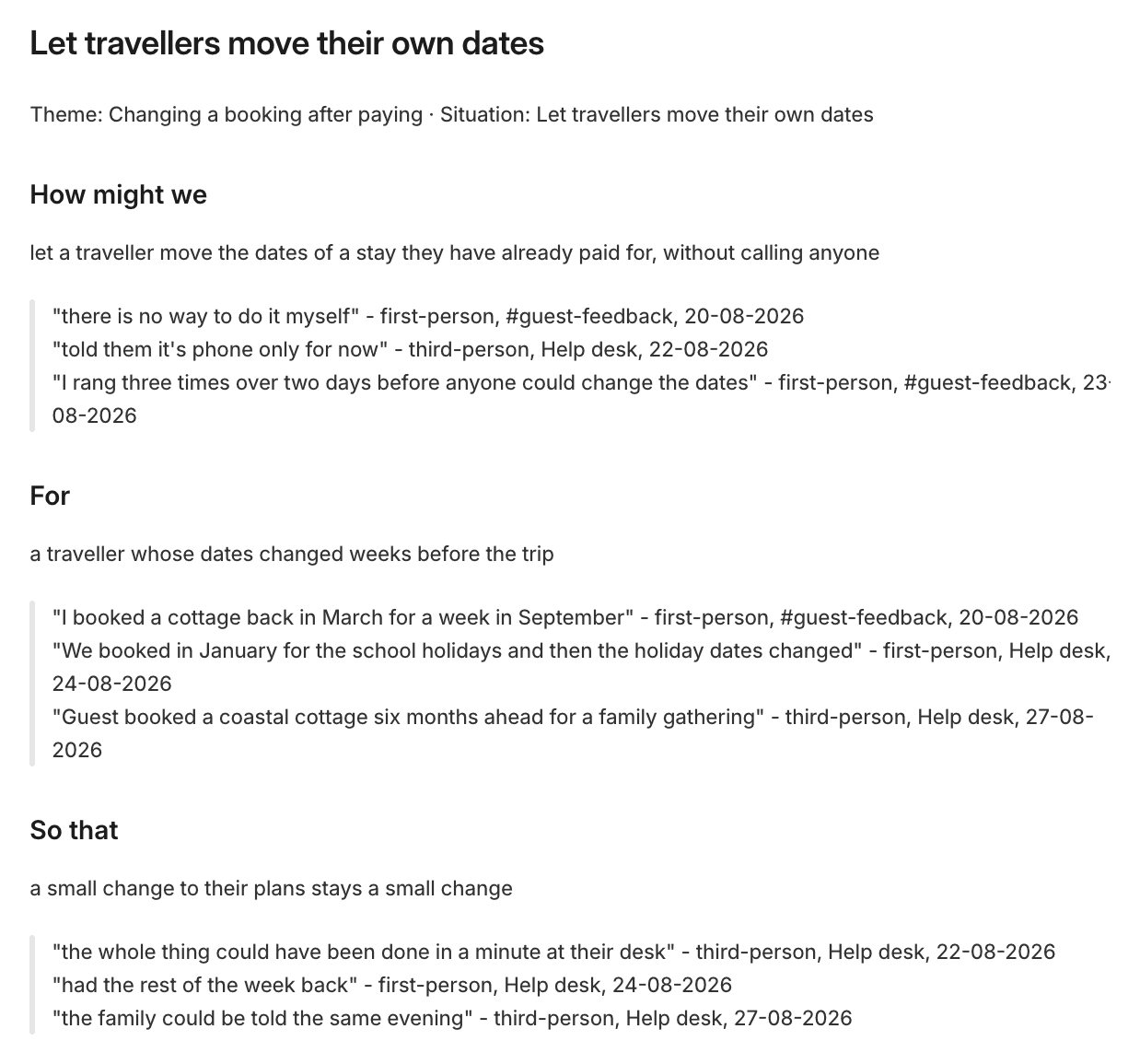
A How might we is one of the four kinds of finding you receive. It arrives as one message in Slack or one issue in Linear, titled with the situation it describes, for example "Let travellers move their own dates". Under the title come its three sections, always in the same order: "How might we", "For", "So that".
Each heading begins the phrase written under it. The first section reads as one sentence: "How might we let a traveller move the dates of a stay they have already paid for". The three sections read in order form one question, and it is a question to explore, not an answer that has been decided.
The finding also carries a theme: the name given to a pattern that several pieces of feedback share.
How it relates to a Problem statement or a Need statement
A How might we is not a rewording of a Problem statement or a Need statement. It has its own quotes under its own sections.
The delivered How might we does not name a Problem statement or a Need statement. What you can see is the theme. A How might we and the Problem statement or Need statement it belongs with carry the same theme, and you find them together by it. In Linear the theme is a label, so you can list every finding under it.
A Need statement says what the person wants. A How might we asks how they could have it.
One theme, a Need statement and a How might we. For example, under the theme "Changing a booking after paying":
- Need statement, "I want to": set new dates for my trip myself
- How might we: let a traveller move the dates of a stay they have already paid for, without calling anyone
How might we
This section names the opportunity. It starts with a verb and names one opportunity only. The person, or the person's experience, is the subject of the sentence.
The section may name your product, a system, a service or a department, because that is the situation the person is in. It does not make the system the subject, and it does not name a feature to build.
A verb first, and the person is the one who acts. For example:
let a traveller move the dates of a stay they have already paid for, without calling anyone
For
This section names the person the opportunity affects: one person, in a situation you can recognise. It is not a group label such as "users" or "customers", and it is not two audiences joined by "and". It may name a product or a system when the person's situation needs it.
One person in a moment, not a category of people. For example:
a traveller whose dates changed weeks before the trip
So that
This section names the outcome for the person: what the opportunity would mean in their life. It states one outcome, in the person's own words.
It never names a product, a system, a brand, a company or a department. A word for something in everyday life that does not belong to one provider, such as a phone or a bank account, may appear. It is not a measure of the system, such as fewer calls or a faster process.
The outcome is stated as the positive state itself. A contrast with the problem stays only when the outcome would mean nothing without it.
What the person gets, not what the system does. For example:
a small change to their plans stays a small change
What arrives with it
Under each section are the quotes that support it, each with its voice, its source and its date.
A note called Confidence states how far the evidence reaches and what it does not cover.
How to read the quotes, the Confidence note and the scores is the subject of article 18.